
 query@authorhousemedia.com
.png)
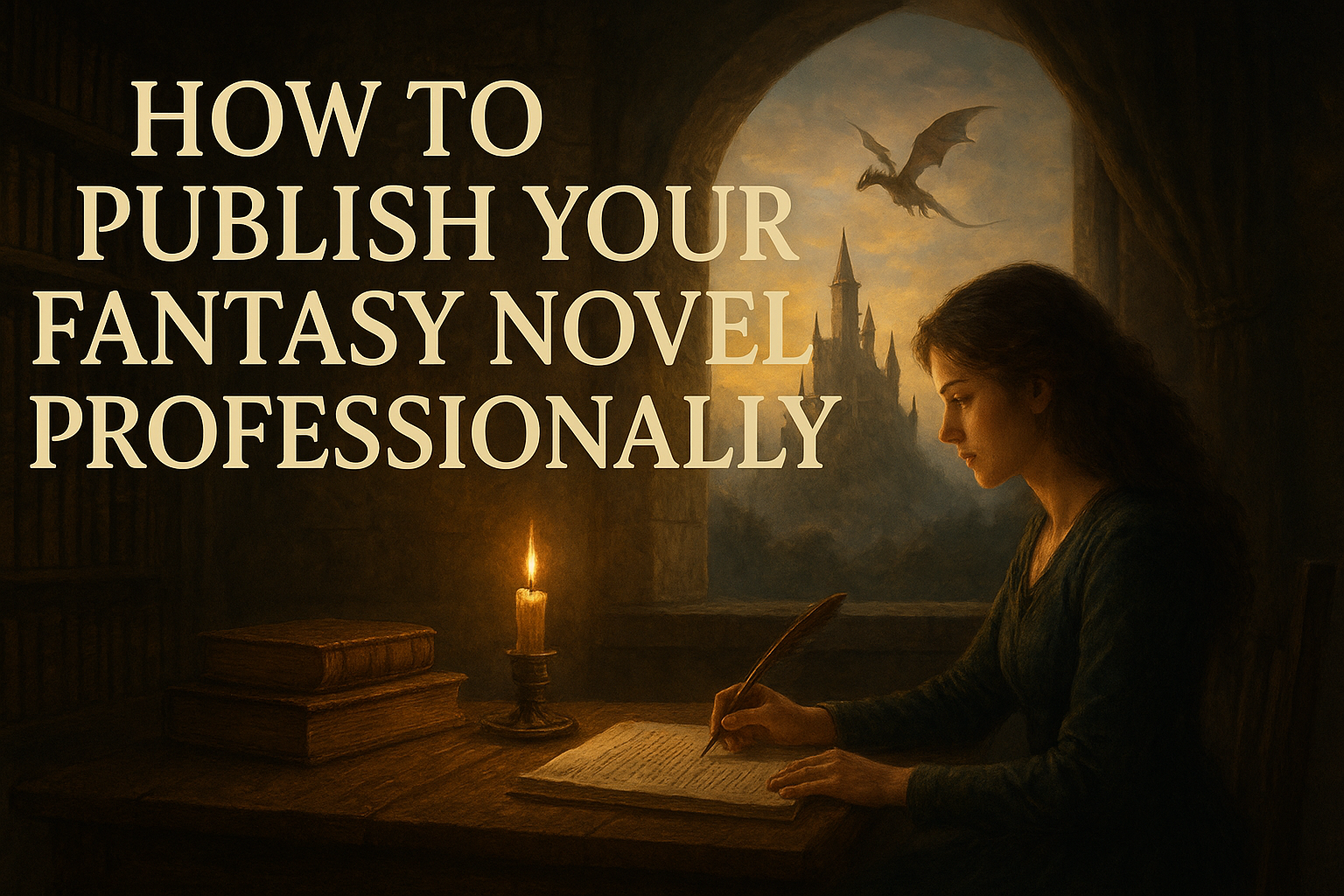
Fantasy literature is defined by its ambition: immense worlds, complex magic systems, and epic journeys spanning millennia. Authors have spent years making that realm. But there is a critical and commercial truth:
The fantasy marketplace is the most competitive and visually demanding corner of publishing.
Readers expect quality rivalling traditional giants. This means that cover art, interior formatting, and world-building consistency must be flawless. A single amateur cover or formatting error can instantly indicate low-quality work. This can sink an author’s epic fantasy novel before it even goes to publishing. Fantasy novel publishers cannot tolerate such work.
Can authors succeed in this regard?
Authors can succeed indeed. However, they need to adhere to specific parameters. They need to move beyond the creative work and adapt to the rigorous and professional mechanics of production.
What it means is that authors must be able to master the genre-specific elements, such as map inclusion, specialized fonts, and metadata that place the book in the right subgenre (dark fantasy vs. high fantasy). It is not just about writing. Instead, it is about creating professional conduct to help authors succeed.
What is the blog’s purpose?
The blog’s purpose is to provide authors with a step-by-step roadmap to publishing their fantasy novel like a seasoned professional. Tactics will be detailed with the aid of experts, enabling authors to hire the best ghostwriters (if needed) and editors, format book interiors, and execute a launch plan, thereby helping their work reach the desired audience.
Briefly understanding fantasy writing
Fantasy is the genre where imagination reigns supreme. The rules of the real world do not bind it. Yet it still has rules (the author’s rules). In its essence, the genre is about exploring the impossible and making it feel quite plausible. Here are its features:
- Worlds that do not exist (Middle-earth, Prythian, Westeros).
- Systems working on magic with unique rules (think wands, spells, and bending elements).
- Mythical creatures (dragons, elves, fairy-like spirits, talking animals and the like).
- Epic conflicts (good vs. evil, survival, revenge, or reclaiming lost thrones).
There is no need to get trapped by tropes. Fantasy is what authors and readers alike make of it. The story does not need to have dragons or wizards. All it needs to do is take readers to an extraordinary destination.
Steps for writing and publishing a fantasy novel
Starting a fantasy novel can give authors a sense of standing at the edge of a vast, unexplored world. The sheer scope of possibilities can overwhelm authors. Ask any editor working at a well-known publishing company specializing in fantasy novels, and they will likely state the same thing, because authors can become overwhelmed.
Yet, learning how to start writing a fantasy book does not have to be daunting, especially if it is approached step by step and systematically. Here are some steps authors can take when it comes to creating their magical world and writing a story that will captivate readers without question:
Starting with a ‘What If’
Numerous fantasy novel publishers state that worthwhile stories in the genre begin with a compelling and straightforward question, i.e., ‘What if?’
These two words can unlock endless possibilities for anyone’s imagination. For instance:
- What if the planet Saturn were a giant prison in the galaxy?
- Or the sun never set on a particular kingdom, plunging its people into limitless daylight?
- What to do if our memories were preprogrammed using a computer?
- What if our memories were someone else’s memories, digitally implanted into our minds?
The ‘what if’ is the story’s seed, i.e., central idea. Once authors have it, it is wise for them to start exploring the implications.
How does this idea impact an author’s world, their characters, and the story’s plot? This foundational question can shape the novel’s entire direction.
Understanding the audience and subgenre
Before authors build their world or write a particular scene, they need to be clear about who they are writing for. This will shape the story’s pacing, tropes, tone, and even word count.
Authors must ask themselves these questions:
- Are you writing for young adult novels or adult fantasy characters?
- Do they want a slow-burning romantic fantasy, a dark epic, or cozy witchy vibes?
- Are readers expecting a standalone fantasy novel or a complete series?
Once they have answered the questions, they must read within the subgenre to see what has been done (and how they can make twists in it). Authors need to visit fantasy writing spaces online (Discord, Reddit, TikTok comments, etc.) to see what readers crave and desire.
The world-building begins (but it should not be overdone)
Worldbuilding is one of the most exciting aspects of writing fantasy novels. The world is the stage where the story’s characters will live, fight, grow, and even subsist. But before authors dive into writing, they must take some time out to sketch the basics:
- Geography: Is the world a sprawling continent, an archipelago, or something unique (like an island floating in the air, a world like Atlantis, Wakanda, or a totally different planet based on Earth’s characteristics, and the like)?
- Culture and Traditions: What are the beliefs, customs, and celebrations of the people inhabiting the story’s world?
- Politics and power structures: Who is ruling those worlds? Is it a Kingdom, A Republic, a Dictatorship, a Totalitarian Stasi State, or an empire? Is the ruling government corrupt? How do they maintain control? Any ancient rivalries, alliances, and rebellions in play?
- Magic and Technology: Is the world deeply entrenched in ancient magic? Or is the world a blend of fantasy and futuristic tech?
Defining the magic system (absence or presence thereof)
Magic is usually the heartbeat of a fantasy novel. Yet, if authors are wondering how to write believable fantasy, it is crucial to establish the magic system’s rules and structure so that it can function correctly.
Even if the story does not include magic, there is likely something extraordinary about its world. It will shape how it functions, whether it involves medieval elements, advanced technology, mystical creatures, or otherworldly phenomena.
Authors must ask themselves the following questions:
- Who can use magic, and how can it be accessed?
- Any limitations of such magic (can it solve a problem, for instance, or does it have some costs and risks)?
- How does this magic affect civilization and society in the story (is it a closely guarded secret, or does everyone wield it?).
Developing compelling characters
Fantasy can be enriched with extraordinary settings. Yet the characters are at the heart of the story. Here is how authors can make them memorable:
Giving them flaws
Perfection in heroes can be boring. Readers connect with characters who struggle. Maybe the protagonist is impulsive, stubborn, not bright, haunted by a tragic past, or has a biological flaw. Flaws create depth and relatability.
Crafting compelling motivations
Authors must ask themselves what the character wants and the reason behind their desire. One driven by revenge acts differently from the other seeking redemption.
Creating complex villains
The antagonist should be more than just evil for evil’s sake. They must have a backstory, motivations, and perhaps some qualities of redemption.
Outlining the plot
No one needs a 30-page outline. Yet they need to know the following:
- The inciting incident (what kicked off the story).
- Rising stakes (what escalated the tension).
- The Climax (what changes the character forever).
- Resolution (how it ends).
Using any structure helps authors craft the following as well:
- The hero’s journey.
- The proverbial save the cat moment.
- Three-act structure.
- Something custom.
Authors must ensure that the story has subplots (such as romance, rivalry, or secrets) that tie back into the main arc.
Writing the story
This is where authors start writing the fantasy novel. The first draft may be scrappy, but it works. Why? Because the authors will edit it later. Here are some tips on surviving a fantasy novel:
- Setting a word count objective that is achievable daily (like 300 to 500 words).
- Writing at their preferred time of the day (morning, Afternoon, Night, lunch break, Supper?).
- Using low-pressure rituals: Tea, playlists, a walk, or anything to get into the mood.
- No need to edit first. Just write it all down and edit later.
Revising with intention
Effective editing involves cutting through filler to enhance pacing. It also helps ensure the character arcs, land, magic, and worldbuilding are consistent, and checks the following:
- Dialogue.
- Tension.
- Transitions.
Using beta readers, critique partners and even professional editors. They are all worth it, whether authors employ the traditional publishing route or the self-publishing one.
How AuthorHouseMedia is Best Publishers for Fantasy Novels?
AuthorHouseMedia stands out as a worthwhile partner for fantasy writers because of its genre-specific expertise. It recognizes that fantasy demands top production quality. They offer the best services necessary for success, including worthwhile cover illustration, interior map design, and complex formatting in both print and digital fixed layouts.
The Excel file excels in ensuring the expansive world-building is presented professionally. This helps reduce errors that are often found in self-published epic stories.
When it comes to marketing tactics, they target the highly competitive fantasy readers segment. This helps guarantee that an author’s meticulously crafted fantasy novel gets the visibility it deserves.
Conclusion
Most fantasy novel publishers agree with the fact that no element in these stories should be overdone. Authors must review their draft once it has been written entirely. Moreover, they must also carefully choose between traditional and self-publishing. For the latter, they will need external editing, formatting and marketing services.
Frequently Asked Questions (FAQs)
Q: Is professional cover art more critical for fantasy than other genres?
A: No doubt about it that fantasy readers have strict visual expectations. Your cover must instantly signal your subgenre (e.g., Epic, Urban) with high-quality, professional illustration. Does this optimize the cost of publishing fantasy novels? Yes, it does.
Q: Should authors include a map in their fantasy novel?
A: Yes indeed. For most high and epic fantasy novels, a professionally designed map is an expectation. It enhances reader engagement and signals world-building credibility.
Q: What is the most common technical error?
A: Formatting complex interiors. Including custom fonts, drop caps, and internal images (like maps) requires specialized knowledge to avoid print errors. Why novel publishing company? Because they help detect such errors.
Q: Where should an author focus their advertising budget?
A: Target your ads at readers of successful, established authors in their specific fantasy subgenre for the highest conversion.